
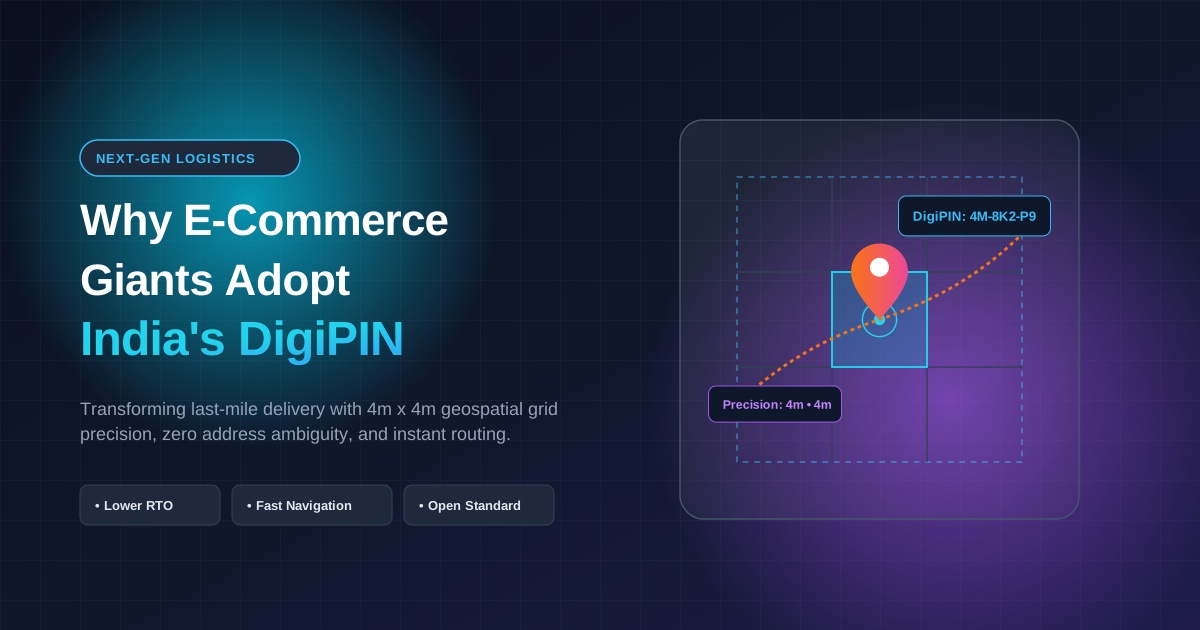
Why E-Commerce Giants Are Fast Adopting India's DigiPIN
Published on August 9, 2026
Quick Answer: E-commerce giants are adopting India’s DigiPIN because its 4x4-meter national geospatial grid eliminates ambiguous text addresses, dramatically slashes Return-To-Origin (RTO) costs, optimizes last-mile delivery routes, and protects consumer privacy through an open digital infrastructure.
The Indian e-commerce market is experiencing unprecedented growth, driven by deep smartphone penetration, affordable mobile data, and expanding consumer demand across Tier-2, Tier-3, and rural regions. However, for quick-commerce platforms, logistics aggregators, and national delivery networks, a persistent operational bottleneck has hindered profitability: last-mile delivery inefficiency.
Traditional street addresses in India are notoriously unstructured. Delivery drivers frequently rely on phone calls, vague landmarks (“behind the main water tank”), and trial-and-error navigation to locate a single customer. To overcome these friction points, the Department of Posts (India Post), in collaboration with IIT Hyderabad, introduced DigiPIN—a open, standardized, national digital address grid system.
Today, major e-commerce platforms, quick-commerce startups, courier companies, and third-party logistics (3PL) providers are rushing to integrate DigiPIN into their core checkout and routing systems. Here is an in-depth analysis of why Indian industry leaders are embracing this revolutionary geospatial framework.
Understanding India’s DigiPIN System
DigiPIN (Digital Postal Index Number) is not merely a digital version of a traditional six-digit PIN code. It is an advanced geospatial addressing system that divides the entire geographical expanse of India—including its territorial waters—into a grid of micro-cells measuring 4 meters by 4 meters.
+-------------------------------------------------------+
|                 INDIA TERRITORIAL GRID                |
|  +-------------------------------------------------+  |
|  |  4m x 4m Cell  |  4m x 4m Cell  |  4m x 4m Cell |  |
|  |  (DigiPIN)     |  (DigiPIN)     |  (DigiPIN)    |  |
|  +-------------------------------------------------+  |
+-------------------------------------------------------+
Core Technical Characteristics of DigiPIN:
- Alphanumeric Precision: Every 4m × 4m area is assigned a unique 10-character alphanumeric code derived from exact latitude and longitude coordinates.
- Hierarchical Grid Structure: The code reflects spatial relationships. Nearby addresses share similar prefixes, simplifying spatial indexing and automated routing.
- Offline-First Compatibility: The mathematical algorithm encoding and decoding lat/long coordinates into a DigiPIN works entirely offline without requiring continuous cloud database queries.
- Open & Interoperable: Unlike proprietary spatial address codes, DigiPIN is an open national standard built to integrate seamlessly into public and private tech stacks via APIs.
The E-Commerce Last-Mile Challenge
Despite advanced algorithmic sorting in central fulfillment centers, the final mile accounts for up to 41% of total supply chain costs. In India, last-mile friction is amplified by unique structural challenges:
- Unstructured & Dynamic Addresses: House numbers are frequently missing, non-sequential, or repeated across different sub-localities.
- High Return to Origin (RTO) Rates: Deliveries fail when couriers cannot pinpoint the recipient’s location within reasonable time limits, forcing expensive returns back to origin hubs.
- Driver Fatigue & Operational Waste: Last-mile couriers waste an estimated 15–25 minutes per delivery neighborhood asking for physical directions or making repeated phone calls.
- Quick-Commerce Demands: Hyperlocal 10-to-20-minute delivery services cannot operate effectively when addresses take minutes to decipher manually.
5 Critical Reasons E-Commerce Giants Are Rapidly Adopting DigiPIN
+-----------------------------------------------------------------+
|              DRIVERS OF E-COMMERCE DIGIPIN ADOPTION             |
+-----------------------------------------------------------------+
|  1. Precision Last-Mile Navigation (4m x 4m Grid Accuracy)      |
|  2. Sharp Reduction in RTO (Return to Origin) Costs             |
|  3. Seamless API Integration & Automated Route Planning         |
|  4. Consumer Privacy Protection (No Detailed Address Leaks)     |
|  5. Universal Interoperability Across Multi-Carrier Networks    |
+-----------------------------------------------------------------+
1. Pinpoint Accuracy Slashes Delivery Times
By replacing broad postal zones with a pinpoint 4m x 4m coordinate grid, delivery personnel no longer navigate to an approximate street—they navigate to the exact front door, gate, or loading dock of a building. For multi-story complexes or large industrial parks, DigiPIN pinpoints the specific entrance, removing the guesswork that stalls couriers.
2. Slashed Return-To-Origin (RTO) and Undelivered Order Expenses
Failed deliveries directly damage an e-commerce platform’s bottom line. When a customer inputs a DigiPIN during checkout, human address interpretation is bypassed entirely. Automated logistics systems convert the 10-digit code straight into spatial navigation points, resulting in:
- Near-zero address parsing errors.
- Reduced dependency on customer availability via phone calls during drop-offs.
- Up to 30% reduction in non-delivery returns in pilot trial regions.
3. Automated Route Optimization & Dynamic Fleet Dispatching
Logistics platforms rely heavily on routing algorithms to minimize fuel consumption and maximize deliveries per hour. Traditional text addresses must undergo complex Natural Language Processing (NLP) to be geocoded—a process that often fails or produces imprecise coordinates.
DigiPIN provides clean, structured spatial data natively. Routing engines can group orders instantly into hyper-efficient delivery clusters. To explore how this spatial grid integrates with broader supply chain infrastructure, read our guide on innovative logistics and asset mapping frameworks.
4. Robust Consumer Privacy Protection
Data privacy regulations are tightening worldwide, and consumer demand for data security is rising. Traditional delivery labels expose full personal addresses, building names, and landmark details to multiple intermediaries across the supply chain.
With DigiPIN, platforms can utilize privacy-preserving, encoded grid coordinates on exterior shipping labels while restricting full textual details to verified delivery agents’ handheld apps during actual drop-off.
5. Seamless Multi-Carrier Interoperability
Large e-commerce enterprises rely on multiple third-party logistics (3PL) partners, regional courier vendors, and hyper-local delivery networks. Standardizing address data across disparate courier tech stacks has historically been a major friction point.
Because DigiPIN is an open government standard maintained by India Post, it serves as a universal spatial protocol. E-commerce platforms can hand off shipments to regional courier partners using a single standardized spatial string that every player in the supply chain can decode without proprietary software locks.
Value Breakdown Across the Ecosystem
The benefits of rapid DigiPIN integration extend far beyond e-commerce marketplaces to every major stakeholder in the Indian commerce ecosystem:
| Stakeholder Group | Primary DigiPIN Benefit | Strategic Impact |
|---|---|---|
| E-Commerce Marketplaces | Higher checkout conversion & reduced customer support tickets | Lower cost-per-delivery and improved customer satisfaction score (CSAT) |
| 3PL & Courier Companies | Optimized fuel utilization & increased successful deliveries/hour | Direct reduction in fleet operating expenditure (OPEX) |
| Delivery Executives | Frictionless navigation without relying on customer calls | Less driver stress, fewer missed targets, improved safety |
| Everyday Consumers | Faster order arrivals, fewer invasive phone calls, enhanced privacy | Streamlined online shopping experience across all platforms |
| Government & Civic Agencies | Standardized national spatial layer for urban planning & emergency services | Enhanced disaster response times and unified public utility management |
How E-Commerce Platforms Integrate DigiPIN at Checkout
Implementing DigiPIN into an enterprise e-commerce tech stack involves a simple, non-intrusive workflow:
[ Customer Checkout ]
        │
        ▼
[ Auto-Detect or Input 10-Digit DigiPIN ]
        │
        ▼
[ DigiPIN Offline/API Decoder Engine ]
        │
        ▼
[ Generate Precise Lat/Long Coordinates ]
        │
        ▼
[ Automated Fleet Clustering & Route Generation ]
        │
        ▼
[ Last-Mile Courier Precision Delivery ]- User Input at Checkout: The consumer selects their location via a mobile map widget or manually enters their 10-character DigiPIN alongside standard contact details.
- Instant Spatial Validation: The frontend uses lightweight client-side JavaScript or an offline API SDK to validate the DigiPIN structure instantly.
- Warehouse Sorting & Dispatch: Fulfillment centers scan the package’s DigiPIN bar code to automatically direct it to the specific dispatch bag reserved for that exact 4x4m neighborhood cell.
- Turn-by-Turn Last-Mile Guidance: The delivery driver’s application receives the precise latitude/longitude point, feeding turn-by-turn navigation directly into their preferred mapping engine.
The Road Ahead: Why Early Adoption Creates a Competitive Edge
As India Post rolls out DigiPIN integration across its vast nationwide infrastructure—spanning over 150,000 post offices—e-commerce organizations that integrate DigiPIN early gain a distinct competitive advantage.
Businesses that incorporate DigiPIN into their logistics stack experience immediate cost reductions in last-mile operations, faster delivery turnarounds, and vastly improved customer retention rates.
As the digital economy expands into tier-3 cities and deep rural pin codes, DigiPIN will transition from an innovative feature to the foundational standard for national commerce, emergency services, and geospatial logistics in India.