
DigiPIN vs PIN Code: Major Differences & Why It Matters
Published on July 29, 2026
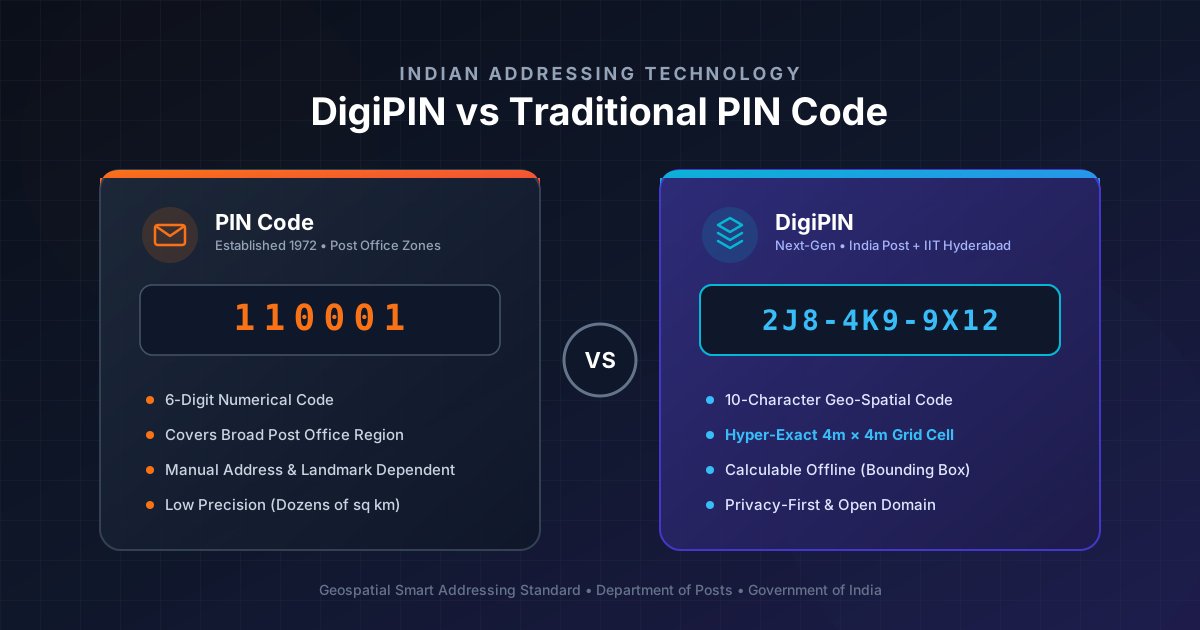
Quick Answer: The traditional PIN Code is a 6-digit regional postal sorting code covering thousands of addresses, whereas DigiPIN is a 10-character geo-spatial digital address system that divides India into precise 4m × 4m grid cells. DigiPIN provides exact pinpoint accuracy for e-commerce, emergency services, and last-mile delivery.
For over five decades, the 6-digit Postal Index Number (PIN Code) has served as the backbone of India’s postal address system. Introduced by the Department of Posts in 1972, it brought order to letter sorting across thousands of delivery regions. However, in today’s hyper-connected era of e-commerce, instant grocery deliveries, ridesharing, and autonomous drone logistics, a system built for physical mail sorting is reaching its technical limits.
To address these modern challenges, the Department of Posts, in collaboration with IIT Hyderabad and ISRO, unveiled DigiPIN (Digital Postal Index Number). DigiPIN is not just a digital upgrade to the old PIN Code; it represents a fundamental paradigm shift from broad regional area codes to hyper-precise, privacy-first geospatial address grids.
In this article, we will break down the exact differences between DigiPIN and traditional PIN Codes, why this technological shift matters for consumers, businesses, courier companies, and government agencies, and how it will transform last-mile navigation.
What is the Traditional Postal Index Number (PIN Code)?
The traditional PIN Code is a 6-digit numerical system designed specifically for manual and semi-automated postal sorting.
How the 6-Digit PIN Code Works:
- First Digit: Defines the geographic region in India (e.g., 1 for North, 4 for West).
- Second Digit: Sub-region or postal circle.
- Third Digit: Sorting/revenue district within the circle.
- Last Three Digits: Specific delivery post office.
Example PIN Code: 110001
[11] North Region/Delhi Circle -> [0] Sorting District -> [001] Connaught Place Post Office
Limitations of the PIN Code System:
- Lack of Precision: A single PIN code often covers dozens of square kilometers, tens of thousands of households, and dozens of confusingly named streets.
- Dependence on Descriptive Addresses: Delivery agents must still rely on lengthy text addresses, landmark directions, or phone calls to find the exact doorstep.
- Ambiguity in Rural Areas: Rural PIN codes cover vast geographical spans with unmapped or unnumbered roads, leading to delayed or failed deliveries.
- No Digital Geo-Coordinates: A traditional PIN code cannot natively feed exact latitude and longitude data into digital navigation systems without third-party geo-coding tools.
What is DigiPIN?
DigiPIN (Digital Postal Index Number) is a nation-wide, open-domain geospatial grid addressing system. Developed in collaboration with academic and space research institutions, DigiPIN partitions the entire geographical territory of India—including its territorial waters—into a seamless matrix of small grid cells measuring 4 meters by 4 meters.
Every single 4m × 4m cell in India is assigned a unique 10-character alphanumeric code based on its precise geographic coordinates (latitude and longitude).
Example DigiPIN: 2J8-4K9-9X12
Grid Resolution: 4 meters × 4 meters
Basis: Geospatial Bounding Box Partitioning (Offline Calculable)
Key Technical Attributes of DigiPIN:
- Off-Line Algorithmic Generation: DigiPIN relies on mathematical bounding box partitioning. The code for any point on the map can be computed locally on a smartphone without needing a continuous database lookup or internet access.
- Hierarchical Grid Structure: Each character added to a DigiPIN narrows down the geographical area from a nationwide zone to an exact 4-meter square.
- Privacy-First Design: DigiPIN only identifies a physical location on earth; it contains zero personal data, occupant names, or property ownership records.
Key Differences: DigiPIN vs. PIN Code
To understand how DigiPIN improves upon the conventional postal system, let us compare their core features side-by-side:
| Feature | Traditional PIN Code | Modern DigiPIN |
|---|---|---|
| Code Length | 6 Digits (Numerical) | 10 Characters (Alphanumeric) |
| Resolution / Target | Post Office Region (Dozens of sq km) | Exact Grid Cell (4m × 4m / 16 sq meters) |
| Underlying Mechanism | Administrative sorting zones | Geospatial coordinates (Latitude/Longitude) |
| Precision Point | Central neighborhood post office | Specific doorstep, gate, or building corner |
| Offline Functionality | Requires post office directory lookups | Pure mathematical algorithm (Calculable offline) |
| Dynamic Capabilities | Static administrative boundaries | Universally continuous across land and water |
| Primary Use Case | Manual mail sorting & regional routing | Automated e-commerce, logistics, emergency dispatch, drone delivery |
Why the Difference Matters Across Key Industries
The transition from a broad sorting region to a 4m × 4m geo-grid brings transformational benefits to everyday citizens, enterprise logistics, emergency responders, and government entities.
1. For E-Commerce & Logistics Companies
Last-mile delivery accounts for up to 53% of total shipping costs. Delivery drivers spend substantial time navigating poorly marked streets, searching for obscure landmarks, or calling customers for directions.
DigiPIN eliminates this guesswork. By directing delivery personnel to an exact 4-meter grid cell, fleet routing software can optimize turn-by-turn paths directly to the recipient’s main gate or delivery dock.
To explore deeper technical workflows on how this spatial system transforms supply chains, check out our detailed guide on how DigiPIN revolutionizes logistics and asset mapping.
2. For Emergency & First Responder Services
In critical medical, fire, or police emergencies, every second matters. Traditional addresses like “Behind the Old Water Tank, Near General Store” lead to dangerous delays.
With DigiPIN, dispatch teams receive an un-ambiguous 10-character location code. Ambulances and fire engines can navigate directly to the specific entrance of a multi-acre complex or an unmapped rural home, saving critical minutes.
3. For Everyday Consumers
- No More Navigation Phone Calls: Drivers no longer need to call you multiple times asking for nearby landmarks.
- Unmapped & Rural Accessibility: Millions of homes in rural or informal settlements lack formal street names or house numbers. DigiPIN gives every individual plot an equal, standardized digital address.
- Simpler Address Sharing: Instead of typing long 4-line text addresses, users can simply share a clean 10-character DigiPIN string.
4. For Government Infrastructure & Urban Planning
Government departments managing utility grids (electricity, water, fiber optic cables), disaster management authorities, and urban planners can tag public assets to exact 4m × 4m cells. This enables comprehensive spatial management of assets without relying on proprietary, paid mapping platforms.
How DigiPIN Works Behind the Scenes
DigiPIN uses a recursive spatial indexing strategy. The system starts with a macro-level bounding box covering the full extent of India’s geospatial boundary.
Level 1: Large Geographic Sector (1st Character)
  └── Level 2: Sub-region Quadrant (2nd & 3rd Characters)
       └── Level 3: Neighborhood Block (4th to 6th Characters)
            └── Level 4: Micro-Grid Cell 4m x 4m (7th to 10th Characters)
Because the boundary logic uses standard mathematical division, converting latitude and longitude into a DigiPIN (and vice-versa) requires minimal computing power. Devices can convert coordinates into DigiPIN codes locally inside apps even when disconnected from cellular networks.
Will DigiPIN Replace the Traditional PIN Code?
DigiPIN is designed to coexist with and enhance the existing PIN Code infrastructure rather than immediately replace it.
- Macro-Routing (PIN Code): National postal systems and regional sorting hubs will continue using the 6-digit PIN Code to route packages from state to state and district to district.
- Micro-Routing (DigiPIN): Once a package arrives at the local delivery hub, the 10-character DigiPIN takes over to handle last-mile dispatch, driver turn-by-turn guidance, and doorstep drop-off.
Over time, as digital map applications, delivery algorithms, and public portals integrate DigiPIN natively, it will become the primary address standard for all digital services across India.
Frequently Asked Questions (FAQs)
What is the primary difference between a PIN Code and DigiPIN?
A traditional PIN Code is a 6-digit number representing a broad post office delivery zone. DigiPIN is a 10-character alphanumeric code identifying a specific 4m × 4m grid location on earth using precise geographic coordinates.
Is DigiPIN a private or proprietary technology?
No. DigiPIN is designed as an open-domain public framework by India Post, IIT Hyderabad, and ISRO. Developers and enterprises can integrate it into their software stack without paying licensing royalties.
Does sharing my DigiPIN compromise my personal privacy?
No. A DigiPIN contains no personal information, owner name, or private identity. It is simply a mathematical representation of a physical spot on earth, similar to sharing latitude and longitude coordinates.
Can I generate a DigiPIN without an active internet connection?
Yes. Because DigiPIN uses deterministic bounding-box math, offline mobile applications can convert GPS latitude and longitude coordinates directly into a DigiPIN code without an internet connection.
Conclusion
The evolution from the 6-digit PIN Code to the 10-character DigiPIN represents a major leap in India’s digital infrastructure. By bridging the gap between broad administrative postal areas and hyper-precise 4m × 4m geo-coordinates, DigiPIN empowers logistics companies with lower delivery costs, enables emergency services to respond faster, and provides every citizen with a reliable digital address.
As adoption spreads across national logistics networks, mapping software, and government portals, understanding and integrating DigiPIN will be essential for modern businesses operating in India.