
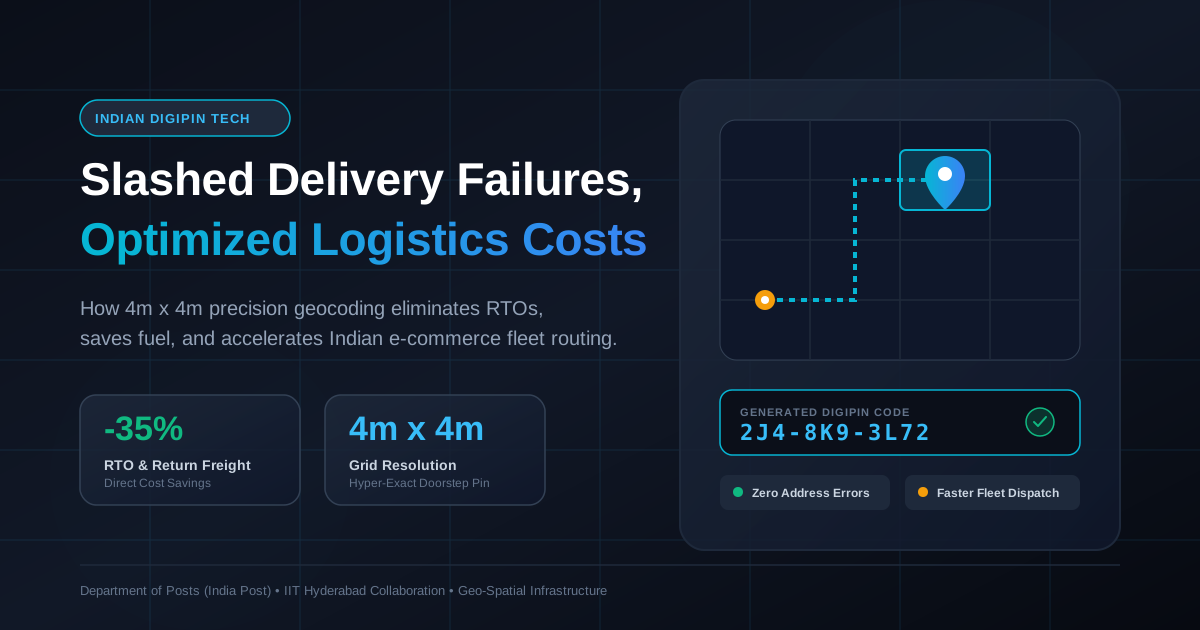
How DigiPIN Reduces Delivery Failures & Logistics Costs
Published on July 31, 2026
Quick Answer: India’s DigiPIN (Digital Postal Index Number) establishes a universal 4m x 4m grid system across the country, replacing ambiguous text addresses with precise 10-character alphanumeric geocodes. By providing exact doorstep coordinates, DigiPIN eliminates last-mile navigation delays, slashes Return-To-Origin (RTO) rates, and significantly reduces fuel and operational expenses for e-commerce and logistics fleets.
The Hidden Cost of Last-Mile Delivery in India
In the rapidly expanding Indian e-commerce landscape, the final mile remains the most expensive, inefficient, and unpredictable stretch of the supply chain. E-commerce platforms, courier companies, and quick-commerce operators face a persistent challenge: address ambiguity.
Traditional six-digit PIN codes (Postal Index Numbers) cover vast geographic territories—sometimes encompassing dozens of square kilometers and tens of thousands of households. When paired with informal, unstructured addressing conventions (e.g., “Near Old Banyan Tree, Behind Sharma Tea Stall, 2nd Floor”), logistics providers face severe operational friction.
The Financial Toll of Ambiguous Addresses
- High Return-To-Origin (RTO) Rates: Failed delivery attempts force packages to be shipped back to sellers, doubling transit costs and freezing inventory capital. RTO rates in Indian e-commerce can range between 15% to 35%, severely eroding operating margins.
- Wasted Fuel and Idling Time: Delivery personnel frequently spend 10 to 15 minutes per order hunting for physical addresses, calling customers for directions, or idling vehicles in crowded urban lanes.
- Driver Burnout and SLA Breaches: Delivery agents fail to complete scheduled daily drop quotas, leading to missed Service Level Agreements (SLAs), customer dissatisfaction, and high driver turnover.
To solve this systemic bottleneck, the Department of Posts (India Post), in collaboration with academic pioneers like IIT Hyderabad, developed DigiPIN—a national, standardized, geo-coded digital address system.
What is DigiPIN and How Does It Work?
DigiPIN (Digital Postal Index Number) is an open-domain, grid-based geocoding system that divides the entire land and maritime territory of India into precise 4-meter by 4-meter (4m x 4m) spatial units. Each unit is assigned a unique, 10-character alphanumeric code derived mathematically from its exact latitude and longitude.
Example DigiPIN Structure: 2J4-8K9-3L72Unlike traditional PIN codes that represent broad administrative post offices, a DigiPIN identifies a hyper-specific location—such as an exact building entrance, delivery bay, apartment gate, or rural farm plot.
Key Technological Characteristics of DigiPIN
- Uncompromised Precision: A 4m x 4m grid guarantees that a courier agent is guided to within arm’s reach of the actual physical door or drop box.
- Offline Computability: The algorithm relies on standard mathematical bounding boxes. Systems can convert GPS coordinates to DigiPINs (and vice versa) without needing constant cloud server hits, making it ideal for low-connectivity rural logistics.
- Hierarchical and Spatial Awareness: Neighboring DigiPIN codes share prefix patterns, allowing route optimization engines to instantly recognize spatial proximity without complex map querying.
- Non-Proprietary & Open Standards: As a public digital infrastructure, DigiPIN avoids expensive licensing fees, enabling seamless integration across government agencies, private logistics operators, and local startups.
How DigiPIN Eliminates Delivery Failures
The integration of DigiPIN into the e-commerce supply chain directly targets the core vulnerabilities of traditional logistics management. Here is how it fundamentally transforms delivery performance:
1. Eradicating “Address Unreachable” RTOs
The primary driver of non-delivery is a courier agent’s inability to locate an address within their assigned shift window. When an address is non-standardized, drivers frequently mark the parcel as “Unreachable” or “Address Incomplete.”
With DigiPIN embedded directly into the order manifest:
- Drivers navigate directly to the 4m x 4m coordinate point using integrated GPS navigation.
- The need for exploratory phone calls (“Sir, micro-wave landmark kahan hai?”) is virtually eliminated.
- Delivery success rates on first attempts skyrocket, driving down costly RTO loops.
2. Streamlining Route Optimization & Batching
Legacy routing algorithms struggle to parse free-text Indian addresses. Even advanced Machine Learning models frequently misinterpret street names or duplicate colony names across different zones of a city.
Because DigiPINs are mathematically structured spatial identifiers, supply chain dispatch engines can:
- Automatically cluster orders located within the same 4m x 4m grid or adjacent cells.
- Calculate optimal driver delivery sequences in milliseconds using pure numerical logic rather than complex natural language processing (NLP).
- Consolidate last-mile dispatch manifests with zero human intervention.
3. Unlocking Efficiency in Rural and Semi-Urban Markets (Tier 2, Tier 3, and Beyond)
E-commerce growth in India is driven by Tier 2+ cities and rural regions. However, these areas suffer most from unmapped roads, non-existent house numbers, and sprawling village layouts.
DigiPIN operates with equal accuracy across high-density urban metro towers and remote agricultural hamlets. A rural artisan or farmer can generate a unique DigiPIN for any doorstep and instantly receive packages directly at their property boundary, opening up vast new markets for national e-commerce brands.
The Economic Benefits: Saving Logistics Costs
Implementing DigiPIN offers measurable financial returns across the entire supply chain value chain.
| Metric | Traditional Addressing | DigiPIN-Enabled Logistics | Direct Business Impact |
|---|---|---|---|
| First-Attempt Success Rate | 65% – 78% | 92% – 97% | Massive reduction in repeat delivery attempts |
| Average Time Saved Per Drop | 8 – 12 minutes | 1 – 3 minutes | Up to 40% more completed deliveries per shift |
| RTO Processing Costs | High (Double freight charges) | Minimal | Restores profit margins on low-ticket items |
| Fuel Consumption | Unoptimized zig-zag routing | Linear, precise pathing | 15% – 25% lower fuel expenses per vehicle fleet |
| Call Center Overhead | High (“Where is my order?”) | Low | Dramatic decline in delivery-related support tickets |
Calculating the Fleet Cost Reductions
Consider a mid-sized Indian logistics operator managing 50,000 daily deliveries:
- Fuel & Distance Savings: By eliminating wrong turns and phone-directed detours, a driver saves approximately 300 to 500 meters per delivery. Across 50,000 drops, this eliminates 15,000–25,000 kilometers of redundant fleet travel daily.
- Driver Productivity: Reducing searching time by 5 minutes per stop enables each courier driver to manage 15 to 20 additional packages during a standard 8-hour shift.
- RTO Cost Mitigation: Reducing RTO rates by even 5% saves tens of millions of rupees annually in reverse logistics freight, inventory lockup fees, and damaged returned goods.
Future-Proofing Supply Chains: Drones and Autonomous Delivery
As India moves toward modernizing its transport infrastructure under the National Logistics Policy (NLP), autonomous systems like delivery drones and sidewalk delivery bots are moving from pilot testing to commercial deployment.
Autonomous vehicles cannot read informal text descriptions like “Opposite Central Bank ATM”. They require absolute mathematical coordinate boundaries to prevent collisions and ensure safe payload releases. DigiPIN provides the native spatial coordinate standard required for:
- Drone drop-offs on designated 4m x 4m landing pads.
- Automated locker drop-offs in commercial hubs and residential complexes.
- Smart city distribution hubs operating with automated guided vehicles (AGVs).
Conclusion: Adapting to the Digital Address Revolution
DigiPIN represents a monumental shift in how physical space is indexed, navigated, and monetized in India. For logistics providers, e-commerce giants, quick-commerce startups, and public utility agencies, transitioning to DigiPIN is not merely an incremental software upgrade—it is a critical strategy for slashing operational expenditure, improving customer experience, and maximizing fleet capacity.
By adopting this standardized 4m x 4m grid framework today, Indian enterprises can eliminate address ambiguity, put an end to wasteful last-mile expenditure, and power the next decade of frictionless commerce.